Categories
Anime Reviews

Anime Review: “Yahari Ore no Seishun Love Comedy wa Machigatteiru やはり俺の青春ラブコメはまちがっている PART 1: GENERAL THOUGHTS

This has been a long time coming; “My Youth Romantic Comedy is Wrong, As I Expected,” or affectionately known as Oregairu, has been an anime that has tugged on my heartstrings since 2013. As of this today, is 2020, the anime has thus concluded, with an ending that satisfies me as an avid watcher. The content is quite long and has spanned years in regards to watching, this review won’t necessarily be one that introspectively dives into the narrative and characters, but it will be one that serves to piece together themes and motifs that I myself have seen, experienced, and gathered whilst watching and following alongside this narrative that seems SNAFU… (Keep in mind, I own NONE of the images below, but there are simply used to provide context on which I review/analyze).

As an educator of English, it is always in my interest to view shows that center around adolescents and the motifs around coming-of-age stories. And Oregairu is nothing short of coming-of-age.
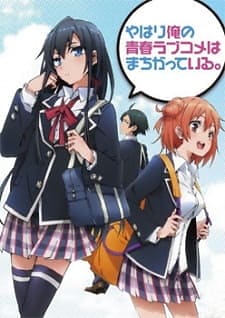
Yahari Ore no Seishun Love Comedy wa Machigatteiru.

The three seasons of the show revolve around the three central characters that live their high school lives, Hikigaya Hachiman (Hikki), Yukino Yukinoshita (Yukino), and Yui Yuigahama (Yui). The trio make up the volunteer Services club, a made-up club used as a punishment for Hikki when he writes an mocking essay on social relationships. There, they try to solve problems that plague the high school day-to-day: all of which seem to center around relationships. And it is here that the central theme of authenticity and genuine of oneself is introduced and played out throughout the entirety of the show. Hikki is socially both socially adept and inept, being able to understand that “today’s generation” revolves popularity and social standing, yet refuses to take part in it. It also doesn’t help his ineptitude that eyes are referred by many in the show as “dead-fish,” invoking the sense that Hikki is classified as “other” to his colleagues and peers.

Classic Dead-Fish Eyes. Happy Birthday 8Man! [OreGairu] : animegifs
Early shot from season 1 of the series, dead eyes and all.

This leads to an interesting dynamic for Hikki, as throughout the series, he is co-erced into fulfilling deeds and services for his colleagues and peers that want to live out their youth! The plight of Hikki and his rebellion against youth drives the show and his relationship with Yui and Yukino. As the show progresses, we see Hikki start to question his own rebellion and youth.And this is where, as a teacher, I am inclined to see the value of how this show questions the zeitgeist of the generation. While I do not live in Japan, it is easy enough to see parallels between these characters and the high schools of today, obsessed with trying to fit in, find love and live their youthfulness until it is time to grow up and be sad. Both Hikki and Yukino hate the ideals of youthfulness, and are drawn to hate how things are. Yui, the third of the trio, lives and thrives in the generation of social media; she is cheerful, knows the slang of her time, and yet genuinely loves the pair. She is the one who tries hard for the sake of others. That isn’t to say the neither Hikki or Yukino are cruel, evil people. They have been casted aside as outcasts, and are products of the society that seems so artificial for them. As I continue to document my thoughts about this show, note that the theme of genuineness is the key to all these characters.
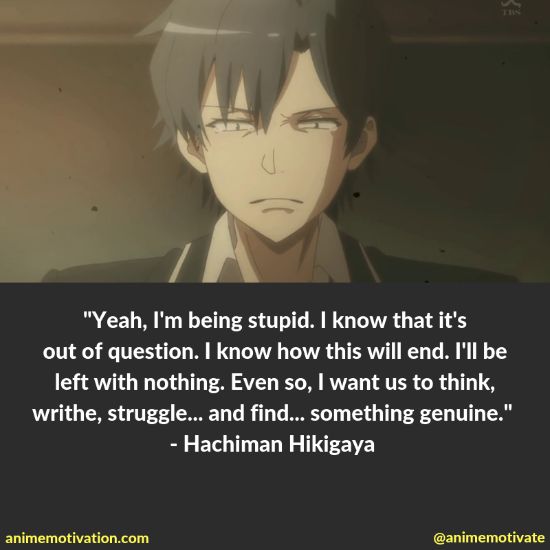
hachiman hikigaya quotes 3 | 70+ Of The Most Memorable Oregairu Quotes That Will Stick With You

I’ll leave my first thoughts here. Think about your time during your youth. How much of your “true self” did you let yourself expose to the world? Did you find yourself seeking other’s approval; did you live vicariously or true? These thoughts I will ponder myself and answer.

Categories
ELA Topics

Haikyuu!! Unit Plan Skeleton

Below is a skeleton Unit Plan on using the anime Haikyuu!! within the context of the ELA classroom. I will later upload the context and rationale on using this particular medium as the “text” for the unit. Please read and enjoy!

Haikyuu Unit PlanFeatures
Common Core Standards:9-10R1: Cite strong and thorough textual evidence to support analysis of what the text says explicitly/implicitly and make logical inferences; develop questions for deeper understanding and for further exploration. (RI&RL)
9-10R2: Determine one or more themes or central ideas in a text and analyze its development, including how it emerges and is shaped and refined by specific details; objectively and accurately summarize a text. (RI&RL)
9-10R3: Analyze how and why individuals, events, and ideas develop and interact over the course of a text.In literary texts, analyze how complex and/or dynamic characters develop, interact with other characters, advance the plot, or develop a theme. (RL)In informational texts, analyze how the author unfolds an analysis or argument, including the sequence, the introduction and development of ideas, and the connections that exist. (RI)
9-10R6: Analyze how authors employ point of view, perspective, and purpose to shape explicit and implicit messages (e.g., examine rhetorical strategies, literary elements and devices). (RI&RL)
9-10R7: Analyze how a subject / content is presented in two or more formats by determining which details are emphasized, altered, or absent in each account. (e.g., analyze the representation of a subject / content or key scene in two different formats, examine the differences between a historical novel and a documentary). (RI&RL) 
9-10R8: Delineate and evaluate an argument and specific claims in a text, assessing the validity or fallacy of key statements by examining whether the supporting evidence is relevant and sufficient. (RI&RL)
9-10R9: Choose and develop criteria in order to evaluate the quality of texts. Make connections to other texts, ideas, cultural perspectives, eras, and personal experiences. (RI&RL)
9-10L5: Demonstrate understanding of figurative language, word relationships, and nuances in word meanings.
Skills:-Developing an analytical and critical view of a text
-Developing a claim/argument
-Utilizing textual evidence
-Identifying themes
-Annotating fiction 
-Collaborative discussion
-Reading comprehension
Anchor Text:Haikyuu!! Seasons 1-4
Additional Texts:Haikyuu Manga by Haruichi Furudate
Materials/Resources:-Anime/Manga
-Slides/Presentations
-Student Technology – Computer/Tablet
-Various Graphic Organizers
Routine Writing:-Formal organized paragraph writing: students will be routinely assigned homework to create topic sentences and supporting evidence

-Daily annotations/note-taking within text

-Weekly journal entries relating to topics within and surrounding

-Daily exit tickets formatively assessing student knowledge
Content Vocabulary:-Literary elements
-Characterization
-Plot
-Conflict
-Foil
-Theme
-Flashback
Performance AssessmentBenchmark Assessment:Research Project:Writing Task:Culmination Project:Writing Task: Students will write a two-paragraph text-analysis in which they create a claim on the text’s theme and support it with details from the text as well as through a literary element (characterization, flashback, conflict).

Culminating Project: Students will create an AMV (Anime Music Video) showcasing the text’s theme, characters, or narrative conflict. Students will create a 1-2 write-up justifying their clip and music choices and how it relates to the text.
Categories
ELA Topics

Fly High into "Literature!" Haikyuu!! as Text – A Unit Plan

Greetings to everyone! I hope that you are well and safe during this truly tumultuous time; schools all over the world are transitioning to online and remote learning— living in NY near NYC, the entire community is about to go on full lockdown. However, learning doesn’t stop, and what better way to learn than with something you are passionate about. For me, my current passion and probably the only thing I’ve cared about this season is season four of Haikyuu!! As I watch the season and read through the manga, I realize that there is something valuable that can be learned through it’s telling. So, while I am working remotely from home, I feel like this is the prime time to continue my practice of unit planning.

In terms of unit planning, I have interacted with four different units and have constructed 3 of them. However, I have yet to utilize anime for the classroom setting, and since I self-proclaimed the title of AnimeELA Sensei, I figure I better put my money where my mouth is. For the next couple of weeks in quarantine, my goal is to fully created a unit around Haikyuu. As always, the key is to start with what I want my students to learn from this “text.” Essential questions can be used as a start. The final output can include one or all of these questions.

  1. How do characters carry the narrative of a story?
  2. How do motifs and symbols embody and push forth the author’s/director’s message?
  3. How does the differences of story-telling (animation versus graphic novel) shape the experience of the story to the reader?
  4. How does a theme influence a story’s narrative? What does the author want to say?

If you have any suggestions on how I should structure this unit, or what you recommend I focus on in this unit, please feel free to ask!

Categories
Real-talk

TEFL, CELTA, or TESOL

Right now, I am currently at a crossroads in my educational path. It is my dream to teach abroad for English Languages learners, specifically in Japan. Of course, being a blog that is dedicated to incorporating ELA and the anime medium has to be centered around the country of Japan, and it’s no secret that I can be a huge weaboo at times. However, before dedicating and committing myself to that opportunity, I need to pick a path for my career— my choices are either getting a TEFL and/or CELTA certification or gaining my masters in TESOL.

At first, the obvious choice is gaining a masters degree in TESOL, being that I need to have one to maintain my current certification in New York State. However, with that, I need to invest a lot of time and money, something that I don’t have much right now (My plan is to hopefully move by this October). While I will eventually obtain one, I think focusing on that in the near future may prove to be inefficient for me.

So it would seem that the current path open for me would be either getting a TEFL or CELTA certification. The CELTA is offered by Cambridge University, and it is one of, if not, the most prestigious certifications for a teacher abroad. The CELTA is a rigorous program, but I think I may be up for the challenge. I think that while TEFL is easier to grasp, it mostly focuses on teaching young learners, while my focus is primarily on adolescent and adult learners. Within the next few weeks, I will make my decision. Here’s hoping for a brighter future. Thank you for reading!

Categories
Real-talk

Back From Hiatus: A Semester of Student Teaching

Greetings to you all and happy holidays! My intent was to create a post at the new year, as a sort of “new year, new me” vibe, but I figure a few days prior to isn’t the worst idea either. I will make a post dedicated to the decade of 2010-2019, but for now, I figure an explanation for my absence is in order.

The past few months, from August to December 20th, I was in preparation for and completed student teaching for NYS certification in Secondary Education for ELA. I had interesting experiences with students of differing abilities and colleagues of many different backgrounds; after the fact, I garnered a true appreciation for the work of educators, especially in the English department. Now that the experience is over and I had a true understanding of what the classroom environment is like as well as planning and executing lesson plans, my objective is start creating lessons and mini-units using anime/manga/gaming/pop-culture as the medium in which students will engage with.

In my personal opinion, I believe there is a way for entertainment to be used productively in a classroom to teach ELA concepts and ideas. Those mediums have been such an impact on my life, I feel that I should share my passion for the mediums whilst creating an opportunity for students to learn. There are other educators who do the same, and I certainly not the first to think of the idea. My hope is to use this platform as a well to collaborate with other educators and students to create a way for ELA skills to develop and strengthen whilst students engage with “texts.” After all, skills are transferable and if you can analyze a character in a game or an anime, you can most certainly analyze a character in a more traditional text. The is to make learning fun and relatable to students’ lives, and to share my passion for ELA through different mediums. Traditional texts will also be used here, as light-novels, poems, one-short short stories are also part of the mediums. Thank you for continuing to follow my journey as an educator and a lover of anime/otaku culture!

Categories
Real-talk

PSA: I’m Not Dead!

Hello readers! AnimELA-sensei here! I apologize for the lack of content between my last post and today. Life had completely got in the way, and I was unable to consistently post (Gosh, has it really been a month since then!?). During this time, I was trying to tie a few strings together in my professional career as well as take care of personal matters. Now that a more consistent schedule for me is approaching, I should be able to post at least once a week (perhaps two, depending on which projects are ready to be posted). I know I promised a review for Rising of the Shield Hero, so look out for that soon as well as some lesson plans and pedagogical theory about using the anime medium in the classroom. I’m excited for the rest of this summer, even though a lot of my time will be preoccupied with other endeavors. For now, thank you for sticking with me, and until then…

-Class Dismissed!

Categories
ELA Topics Real-talk

On the Topic of Criticism

Criticism, in its base root, comes from the word critique: a detailed analysis of something. It is a written work, of which deep thought and care is used to convey a meaning or a message—particularly, it engages concepts, ideas and other works of art as observed by people. As Matthew Arnold writes, in his essay, The Function of Criticism, I am deeply interested in his definition of criticism: “A disinterested endeavor to learn and propagate the best that is known in the world.” (50) This definition of criticism is something that I believe drives people to continually strive to make art and pursue their passions. The proverb of “iron sharpens iron” does indeed hold up to this function of criticism; the best way to make art is to be able to discern what makes good art and the process in which to create it. As such, an archive is needed to house those ideas. For the critic, he or she must be able to create a portfolio and a criteria of which to value and judge art, cuisine, the passions, and even interests and hobbies. What forms should it take then? In what way can a critic begin to process and parse through life and strive to find the best in the world?

To begin understanding how critics can begin to formulate good taste and propagate the best in the forms, an understanding of who the critic is and to whom the critic is writing to must be clarified. In short, the critic is meant to be an outside advisor for the artist or the expert. The critic should be knowledgeable about the very subject that they are critiquing. Does that mean a critic can’t be an amateur? Not necessarily so! A critic is someone who is informed—someone who cares about the very thing they are critiquing. Why would someone who hates Asian cuisine write or critique about Asian food? Simply put, a critic is a person who cares. Generally so, since he or she is informed about a subject, to be a critic is to desire to seek the best. According to John Ransom, in his seminal essay, Criticism Inc., he notes peculiar competencies that the critic himself or herself should have. “He [or she] should know good art when he [or she] sees it; but [their] understanding is intuitive rather than dialectical… It is true that literary artists, with their command of language, are better critics of their own art than are other artists, probably the best critics of poetry we can now have are the poets.” (327) The critic writes to inform the artist or expert so that they can continually strive to seek the best that humanity can provide; the critic also informs the masses, so they too can become informed. It is my belief that so long as a person can become informed and seek to desire the best in whatever they are impassioned for, anybody can indeed become a critic. And the critic uses multiple forms to convey their message.

Profiles, reviews alongside essays, and lists serve as examples that propagate this modal process of parsing for the best of any given thing. Profiles are used to give background information about something. To evaluate art or music, a context should be adhered to by the critic. Reviews seek to take something in isolation and carefully observe it for what it is. Take a movie, for example: A critic reviews the movie on multiple levels—whether that is through the film making, the editing, the narrative and plot design, and deeply analyzes it for what it is. Is this movie inspiring? Does it pay homage to its predecessors? Is it just titillating for titillating’s sake? The critic uses reviews to have a deeper introspection into whatever he or she is reviewing. Listing is a very peculiar way of organizing thoughts about a particular subject, whether it be in art, cuisine or anything really. The purpose of the list is to make classifications and intentionally places criteria to base its clarifications on. This is a good practice for critics to uphold. There are other practices that critics should maintain if they are to be good critics.

Critics should have a mastery of language. They should know how to write well and present their information with grace, adeptness, and with intent. A good artist knows how to create good art, and so too must a critic be a good critic. Criticism then, is a form of art itself, for the critic must present him/herself to the audience so as to inform them and propagate the best. How can a critic be a sound source and person for the people if he or she cannot eloquently convey their thoughts on the subject? A good critic knows how and when to use domain-specific language that connects with the audience. The best critics have their own voices and styles of writing. They are able to succinctly express their tone and it be clear to the audience their intent.

Another school of thought to good criticism is to not only praise the good about something but to also be negative about it. Negativity, in today’s society, is often not utilized by the masses. People don’t want to be negative because they are afraid of hurting the artist’s feelings. To be a good critic is to not attack the artist but the art itself. Dwight Garner writes in the New York Times article, “A Critic’s Case for Critics Who Are Actually Critical” about this in particular reference to book reviewing.

The sad truth about the book world is that it doesn’t need more yes-saying novelists and certainly no more yes-saying critics. We are drowning in them. What we need more of, now that newspaper book sections are shrinking and vanishing like glaciers, are excellent and authoritative and punishing critics — perceptive enough to single out the voices that matter for legitimate praise, abusive enough to remind us that not everyone gets, or deserves, a gold star.

Critics should be negative, for it is by being negative that we can make discernments about art. The negative route emboldens the notion of seeking to find the best in the world. It isn’t pretty; it’s painful; but it’s necessary. Negativity looks for the ways in which the work can be improved, and if the artist looks past the negativity, the artist can make better choices in the future and craft something better.

Theoretical Resources:

John Crowe Ransom, “Criticism, INC” (1941)

Dwight Garner, “A Critic’s Case for Critics Who Are Actually Critical” (2012)

Matthew Arnold, “The Function of Criticism at the Present Time” (1864)

Categories
ELA Mini-lessons ELA Topics Uncategorized

Mini-lesson: Anime Openings

What hooks people into a show? Is it because of the stirred-up drama or sensational hilarious comedy sketch found in the cold opens? Are the characters that engaging from the get-go? I think openings play a major role within a show’s success. They tell a mini-story about the anime, showing off animation styles, introducing certain themes and motifs of the shows. There’s so much to sift through and analyze about it, that there are content creators who spend A LOT of time breaking down and dissecting these 1:30~ clips. We can even look at one of the world’s most popular show, Shingeki no Kyojin, affectionately titled Attack on Titan or AoT for short, and how each opening gives a specific emotion associated with it. From the ‘dystopian’ war cry of the first opening to the more anthem-driven second opening featuring the Levi squad and the Survey Corp, openings make a big difference to the overall feel of the show.

My favorite Opening. It just has a victorious ring to it!

Endings are just as important, for not only are they the credit sequence to acknowledge the hard work of the animators and creators who made the show, but there are other visual elements that make a lasting impact to the audience that the ending can tell the audience. Admittedly, I’m the type of watcher who skips the endings to watch the next episode because I don’t have a ton of time to watch weekly episodes–unless it’s Shield Hero… (I’ll also be doing my personal take on that show later this summer, so watch out for that!)

That level of enthusiasm from NPH describes my inner feelings for my favorite shows every week…

Now that I ranted for too long, here’s the actual mini-lesson:

Lesson Plan Template

Unit Topic:  Understanding Motifs and Themes Through Anime Openings 

Target Audience: 10th grade 

Learning Objective: Students will be able to use their working knowledge on motifs and themes and aptly apply them to a living work, video production. 

Materials:

  • Graphic Organizer – Comparing motifs and themes found in Attack on Titan’s second and third openings 
  • Laptops 
  • Editing Software 
  • Access to Youtube and other media platforms 

Instruction:

  • Do-now: What is your working definition on motif and theme? 
  • Teacher will go over with students on the concepts 
  • Students will watch Attack on Titan’s second opening and write down their take on motifs and themes expressed throughout the opening. Then, they will watch the third opening and again write their take on the opening. 
  • Students will do a turn-and-talk, sharing their thoughts and notes
  • Teacher will go over the organizer.
  • Teacher will then go over the project: Create an Anime opening! By yourself or in pairs, you will get a chance to create an “anime-style” opening. Using [insert editing software here], you will use clips and song choice to make an opening sequence your own. What is your favorite anime or show? How will you convey the best or sensational parts condensed into a minute and a half?
  • Students will also prepare a three — five-minute presentation on the clips and music choice as well as the motifs and themes chosen to display within your opening.

Assessment of learning Objective/Closure:

  • Each student will present their opening to the class. Rubric may be used. (I usually prefer to create a rubric with students so they may know exactly how they will be created in regard to criteria) 
  • Students will receive an organizer to document and note motifs, themes and other thoughts they may have. 

Learning Standards:

CCSS.ELA-LITERACY.RL.9-10.4 
Determine the meaning of words and phrases as they are used in the text, including figurative and connotative meanings; analyze the cumulative impact of specific word choices on meaning and tone (e.g., how the language evokes a sense of time and place; how it sets a formal or informal tone). 

CCSS.ELA-LITERACY.RL.9-10.5 
Analyze how an author’s choices concerning how to structure a text, order events within it (e.g., parallel plots), and manipulate time (e.g., pacing, flashbacks) create such effects as mystery, tension, or surprise. 

CCSS.ELA-LITERACY.RL.9-10.6 
Analyze a particular point of view or cultural experience reflected in a work of literature from outside the United States, drawing on a wide reading of world literature. 

CCSS.ELA-LITERACY.RL.9-10.7 
Analyze the representation of a subject or a key scene in two different artistic mediums, including what is emphasized or absent in each treatment (e.g., Auden’s “Musée des Beaux Arts” and Breughel’s Landscape with the Fall of Icarus). 

CCSS.ELA-LITERACY.SL.9-10.5 
Make strategic use of digital media (e.g., textual, graphical, audio, visual, and interactive elements) in presentations to enhance understanding of findings, reasoning, and evidence and to add interest. 

Feel free to make use this lesson and make changes to it. Let me know how I can improve the lesson project. Thank you for reading!

-Class dismissed!

Categories
Real-talk

Summertime Projects!

June is the start of summer, and it is the start of summer projects. For me, I have a list of projects that I want to work on. I am giving a helping hand to a producer in regards for storyboarding a plot for his albums. I have not done much work in regards to the creative and narrative side of writing; most of my work primarily is either informational or professionally-based, so it will be rather interesting how I go about creating characters instead of analyzing them. (It’s sure to be fun!)

Other projects include reviews of anime and anime sub-communities, ELA mini-lessons with anime as the crux—I am currently writing a mini-essay on the topic of anime video-essays (meta, I know). I am also working on fixing my Tumblr, which I haven’t used since I was finishing up my associates degree back in 2016. It’s a more personal Tumblr, mostly filled with cute anime girls and personal writing–as if here isn’t already personal enough with my passion for teaching ELA and anime and my honest opinions on each–check it out if you like. It may not be everyone’s cup of tea, but I plan to keep my old reviews and writing on there, full of grammatical, syntactical and structural issues; I believe it’s important to keep the old stuff, purely because it’s keeps me honest and humble with myself, especially as I teach students who are beginners at writing. We all start from somewhere, and so by keeping my old things the way the are currently, it helps me be a better teacher.

Shameless plug of my Tumblr

I will, though, re-write the reviews on my Tumblr, adding a bit more of the “blog-ish” flair, for I have been seriously lacking in that skill of my writing. Hopefully, as I continue to use this as a resource for myself and other ELA teachers who wish to use anime in the classroom, my creative endeavors will progress and improve.

For now though, please continue to read and enjoy my writing, and I hope that I can be a better resource for writers and other teachers. Also, please leave a comment or connect with me. I’m very open and desiring to create a community to push non-traditional forms of media (and traditional, of course) in the modern classroom.

-Class dismissed!

Categories
Real-talk

The Journey Begins

In my journey to becoming an ELA teacher, wanting to work with students domestically and internationally, I realized that a pinnacle and pivotal medium that immersed me into the world of fantasy and escape was anime; my passion is help others find their passion. Language Arts, in this case, English Language arts, are in an interesting position in the United States when it comes to non-traditional creative mediums. In an age where technology, the internet, and pop-culture continue to thrive and make headway into the mainstream, it is inevitable that such a popular form of media in anime–one that is dear to me– will make it’s way into the classroom. Look at Crunchyroll, Netflix and Hulu and the rise in popularity that the anime art form: it doesn’t take a genius to know that people, especially young people are becoming introduced to it. Whether enjoyed as cathartic, pleasing, or just damn good fun, there is so much potential to be had combining learning and anime. And this isn’t a ploy to get students to rigorously study (unless you are that kind of student. In that case, go in guns blazin’) There is valuable storytelling and language arts skills waiting to be learned. Unlocking those skills may lead those into the creative field, or at the very least, it may help people think into deeper layers and meanings rather than just what’s on the surface level. This blog is for teachers, students and those who just enjoy anime (and manga too!) The journey begins…

“The difference between the novice and the master is that the master has failed more times than the novice has tried.”

-Koro Sensei (Assassination Classroom)

Animemotivation.com
post
Design a site like this with WordPress.com
Get started